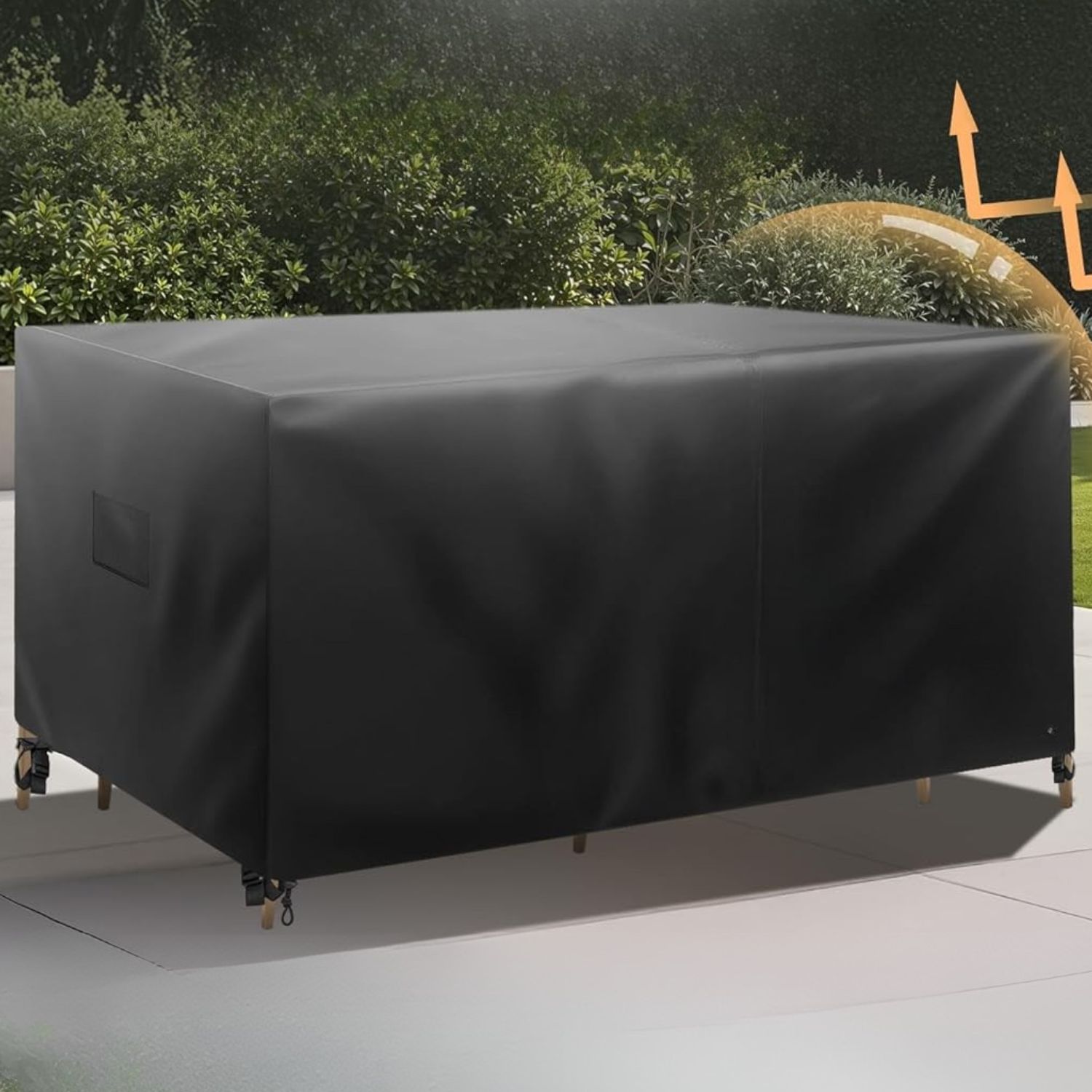

The Complete Guide
How to Choose the Right Outdoor Table & Chairs Cover
Why Your Outdoor Dining Set Needs a Cover
Australian conditions are uniquely demanding on outdoor furniture. The UV index regularly exceeds 11 — the scale's maximum — in summer across most of the country. Coastal humidity accelerates corrosion and mould growth. Spring storms arrive fast, afternoon sun bakes whatever the morning rain soaked, and temperature swings between seasons can stress materials to the point of failure.
A quality outdoor dining setting cover solves several of these problems simultaneously. It blocks UV before it hits your cushion fabric. It sheds rain rather than letting it pool on seat pads. It keeps pollen, bird droppings, and dust off your table between uses. The cost of a good cover is measured in dollars. The cost of replacing a quality outdoor dining set runs into the hundreds or thousands.
What Makes a Good Outdoor Table and Chairs Cover
Material weight and weave
The single most important specification is the fabric weight, measured in grams per square metre (gsm). A cover below 200gsm will fade within a season in direct sun, and the waterproof coating — applied to the back of the fabric — starts failing within a year of regular use.
The 420D Oxford fabric used in this cover is substantially heavier and tighter than budget polyester covers. The "D" stands for denier, a measure of thread weight. 420D Oxford is a tight, interlocking weave that resists abrasion from wind-blown debris, holds its shape under repeated folding and unfolding, and holds a waterproof coating far more durably than cheaper weaves.
The silver-coated UV layer on the reverse side is an important addition. Many covers rely solely on fabric thickness to block UV, which leads to gradual breakdown of both the fabric and the furniture underneath. A reflective silver layer actively bounces UV radiation rather than absorbing it — protecting the furniture and extending the life of the cover itself.
Waterproofing: Fabric and seams together
The outer fabric being waterproof is the obvious requirement, but the seams are where most covers eventually fail. Stitching creates rows of needle holes through the fabric, and water exploits these through capillary action — tracking up through the holes and onto the underside.
There are two effective approaches: PU-taped seams, where a strip of polyurethane tape is heat-bonded over every stitch line from inside; and double-folded, twice-stitched seams that compress the fabric layers tightly enough to block water entry. This cover uses PU-taped seams on every joint, which eliminates the seam leak path entirely.
Ventilation and mould prevention
Covering outdoor furniture traps air underneath. In the humidity levels common to Queensland, coastal New South Wales, and tropical areas, trapped air quickly becomes saturated with moisture — and that moisture condenses on the cool surfaces of your furniture overnight. This is how mould develops under even a high-quality waterproof cover.
Air vents on the sides of this cover create a chimney effect that allows moisture-laden air to escape. The vent placement is designed so that driving rain from any typical angle cannot enter, while gentle air circulation continues underneath.
Wind resistance
A cover that blows off in a storm is worse than no cover at all. Beyond leaving the furniture exposed, a flailing cover can scratch polished table surfaces and become a hazard in high winds.
The buckle strap system on this cover cinches around the base of the furniture to anchor it. The elastic hem cord provides a continuous seal around the perimeter. For particularly exposed positions — coastal properties, elevated decks, or open rooftop terraces — adding cover clips along the lower hem gives an additional layer of security.
How to Measure Your Patio Dining Setting
Accurate measurement is the difference between a cover that fits well and one that fights you every time you put it on.
Set up before measuring. Push all chairs fully into their normal position around the table. The cover needs to fit the arrangement as it typically sits, not the table alone.
Measure width and depth across the full footprint. Measure from the outermost point on one side to the outermost point on the opposite side — not just the table edge. Chair feet and armrests often extend slightly beyond the tabletop, making the true footprint larger than the table dimensions alone.
Measure the height to the tallest point. For dining chairs this is usually the top of the chair back. If your chairs have high backs or headrests, measure to the highest point in the arrangement.
Allow cover clearance. A cover that matches your furniture's exact dimensions will be difficult to pull on and will strain the seams over time. You want the cover to be at least 5–8 cm larger than your setting in every dimension. This 188 × 188 × 71 cm cover fits settings up to approximately 180 × 180 × 70 cm.
Fixed Size vs Custom Made: Understanding the Difference
A fixed-size cover like this one is the right choice for furniture that sits within standard dimensions. They cost less than custom covers, ship within 2 business days, and work perfectly for the majority of standard outdoor dining configurations.
Custom-made covers become the better option when:
Your table is rectangular, not square. A square cover on a rectangular table will bunch at the ends and leave the long sides inadequately covered.
Your setting is significantly larger than standard. If your dining table seats 10 or 12 people, the standard sizes simply won't reach.
You have an unusual configuration. Corner settings, L-shaped configurations, or settings that include a side table need a cover built for that specific shape.
You want a tailored look. A custom cover cut to your exact dimensions sits cleaner, drapes more evenly, and looks more considered than a cover with excess fabric on the sides.
Custom covers from this site are made from the same 200gsm solution-dyed waterproof polyester and start from $69, with pricing based on the total fabric area required.
How to Get the Longest Life from Your Cover
Allow furniture to dry before covering. If your setting has been rained on, give it 30–60 minutes in the sun before covering. Covering damp furniture — especially timber — accelerates mould regardless of how well-ventilated the cover is.
Clean the cover regularly. Dust, pollen, and bird droppings accumulate on cover surfaces and, if left, begin to break down the UV coating. Brush the cover down with a soft broom and wash with warm soapy water once or twice a season. Avoid pressure washing — it degrades the waterproof coating over time.
Fold loosely for storage. If you're storing the cover for an extended period, fold it loosely rather than tightly packing it. Tight creases weaken the fabric at fold lines over many cycles. Store in a cool, dry location away from direct sunlight.
Inspect the seams and coating annually. Run your hand along the seams inside the cover and check for any points where the PU tape is peeling or the waterproof coating is flaking. Small areas of degradation can often be treated with a fabric waterproofing spray before they become a bigger problem.
Common Mistakes to Avoid
Measuring the table but not the setting. The table is almost never the widest point of the arrangement when chairs are pushed in. Chair feet, armrests, and cushion overhangs all add to the footprint. Always measure the full arrangement.
Choosing the smallest cover that technically fits. A cover with zero clearance strains at every point and will wear through at the stress points first. The 5–8 cm of clearance built into this cover's dimensions is intentional and worth keeping.
Assuming all 420D covers are equal. The denier rating refers to thread weight, but weave density, waterproof coating type, and seam construction vary significantly between manufacturers. Check that any cover specifies PU-taped or double-stitched seams — not just a waterproof fabric.
Leaving the cover on indefinitely. A cover that never comes off prevents the furniture from drying out completely, which can trap residual moisture and encourage mould even in a well-ventilated cover. Taking the cover off on dry, warm days for a few hours gives both the furniture and the cover a chance to breathe.
Covering furniture that is still wet. This is the single most common cause of mould under covers. Even 20–30 minutes of sun exposure before covering makes a real difference, particularly for settings with cushions.